


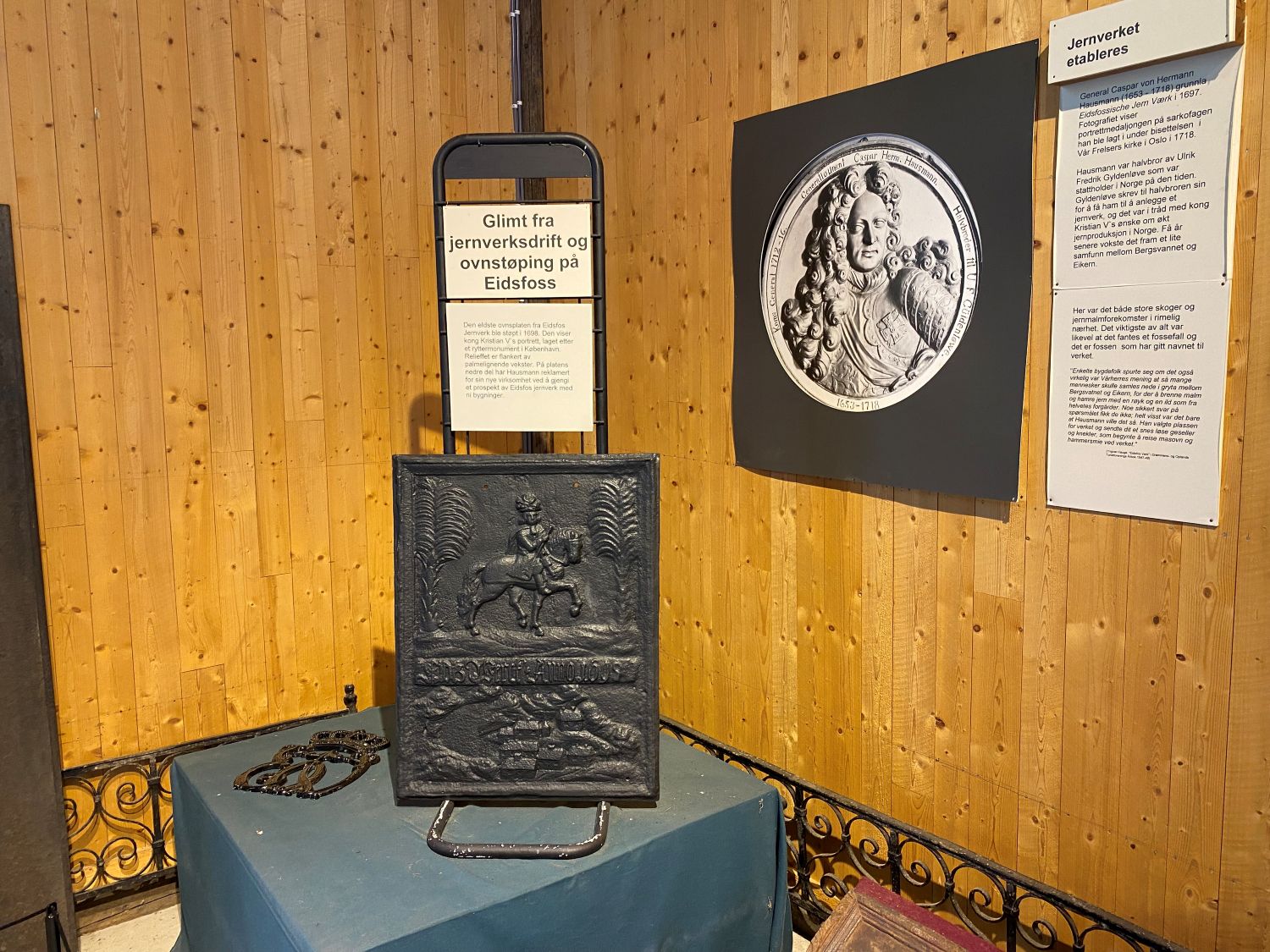
Photo: A replica of the furnace plate from 1698 is on display at the Ironworks Museum in Eidsfoss.
5 things you might not know about Eidsfoss
Eidsfoss is perhaps best known for its old workers’ housing, its ironworks history and its stove production. But did you know that the industrial history here stretches all the way back to the Middle Ages, and that Eidsfoss also has a history encompassing both early railway production and tourism?
Here are 5 things you might not know about Eidsfoss.
1. Hydropower was the driving force behind Eidsfoss’s industrial development
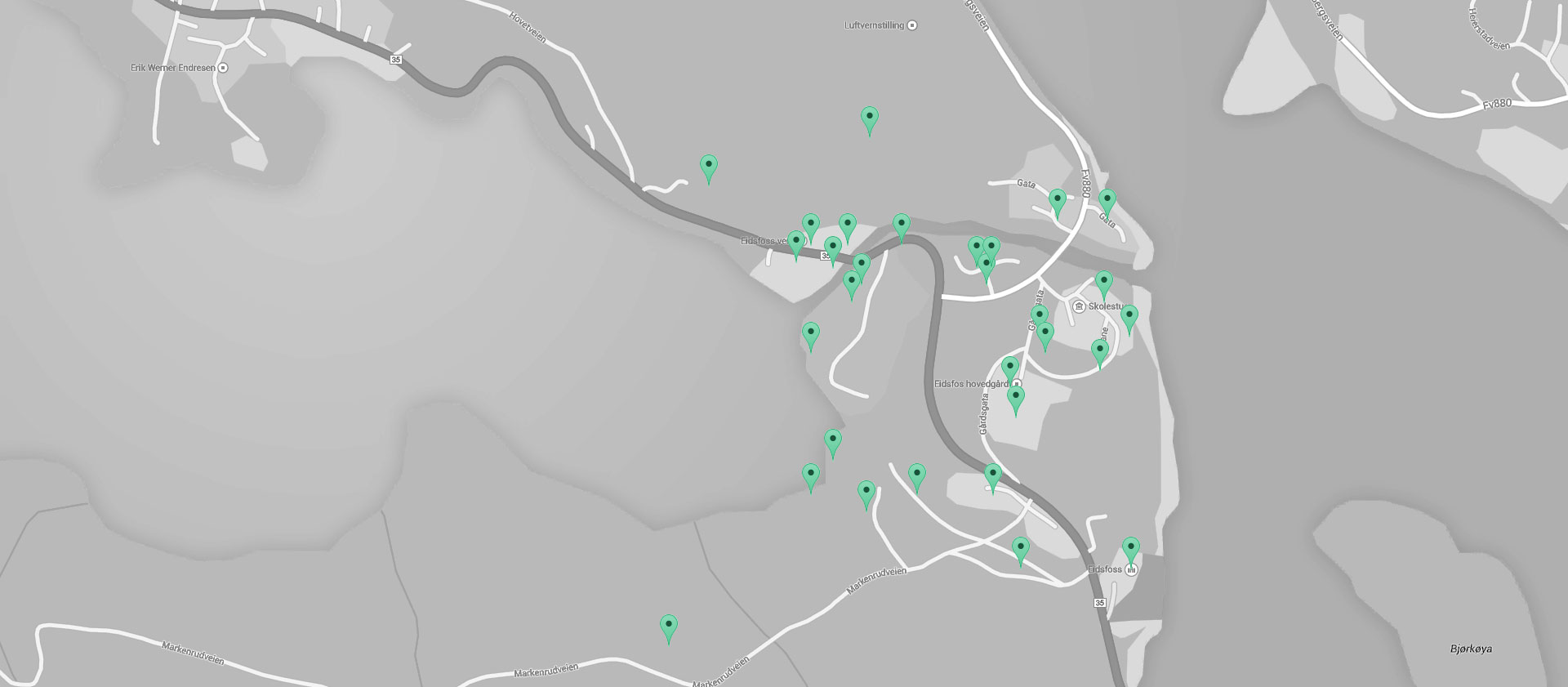
The 17-metre drop in the Eidselva river made hydropower a vital resource in Eidsfoss long before the ironworks were founded.
As early as the 14th century, there were three mills along the river between Bergsvannet and Eikern. In the 16th century, the water-powered up-saw arrived in Norway. By 1545, there were as many as two sawmills in Eidsfoss, and in the 17th century there were up to three.
Hydropower also drove the iron production itself. Among other things, it was used to power the bellows that maintained high temperatures in the blast furnace, and to drive hammers and other equipment. Much of the industry was therefore situated along the river.
2. Eidsfos Ironworks was founded to compete with Swedish iron
In 1697, Eidsfos Ironworks was founded as part of the Danish-Norwegian king’s efforts to make the kingdom less dependent on Swedish iron. Relations between Denmark-Norway and Sweden were becoming increasingly strained, and King Christian V wished to strengthen domestic iron production.
Eidsfoss was an ideal location for an ironworks. It offered hydropower, extensive forest resources, access to iron ore and good transport links. The conditions were therefore well suited to establishing a large-scale ironworks operation.
3. The first furnace plate from Eidsfoss dates from 1698
Just one year after Eidsfos Ironworks was founded, the first known furnace plate was cast. It dates from 1698 and is more than just an old piece of cast iron.
The design depicts Eidsfoss with nine different buildings, and King Christian V is portrayed on horseback. The furnace plate thus offers a rare glimpse of what the new ironworks looked like in its very early days – before the large industrial community comprising Gata, Bråtagata and Hauane had developed.
Today, you can see a replica of this furnace plate at the Ironworks Museum in Eidsfoss.
4. Eidsfoss had one of the country’s largest railway carriage factories
Eidsfos Verk produced goods wagons for the Tønsberg–Eidsfoss railway line, and production was gradually expanded to include several types of railway carriages.
By 1938, when the private railway was closed down, the business had grown into one of the country’s largest manufacturers of railway carriages. Production was later moved to Sundland in Drammen, where it continued until the late 1960s.
5. Eidsfoss was a tourist destination as early as over 100 years ago
Eidsfoss was a tourist destination as early as around 1900. When the Tønsberg–Eidsfoss railway line opened in 1901, tourists from Kristiania could take the train to Vestfossen, a steamboat across Lake Eikeren to Eidsfoss, and then the train on to Tønsberg. Eidsfoss station also served as a hotel offering accommodation and a restaurant – and had a female manager!
Eidsfoss was, therefore, a tourist destination long before today’s cafés, galleries, museums and cultural events made the place popular with visitors. The interesting combination of the ironworks, water, forest and railway was already an attraction back then!
In other words, Eidsfoss is much more than just an old ironworks. From hydroelectric power and industry to railways and tourism, the place has been constantly evolving over several hundred years.
Next time you visit Eidsfoss – take the time to have a closer look. You might discover a story you never knew existed!