


The Old Eidsfos Foundation – the fight to preserve Eidsfoss
The Foundation for the Active Preservation of Cultural Heritage and the Environment at Eidsfoss, commonly known as the Old Eidsfos Foundation, was established on 4 May 1979. The aim was to prevent the demolition of the old buildings at Eidsfoss, generate new activity and breathe new life into the small industrial community which, in the 1970s, had come to resemble a ghost town.
The first board consisted of Erling Braathen, Selma Stene, Sidsel Vagnild (treasurer), Maren Nilsen (secretary) and Fred Nordseth (chairman). The deputy members were Taave C. Nilsen and Lillan Thunberg.
Since its establishment, countless hours of voluntary work have laid the foundations for Eidsfoss as we know it today. The total number of hours of voluntary work is estimated at over 35,000. Today, there are around 60 buildings worthy of preservation linked to the mill’s history, and the Old Eidsfos Foundation is responsible for 16 of them.
Threatened with demolition in the 1970s
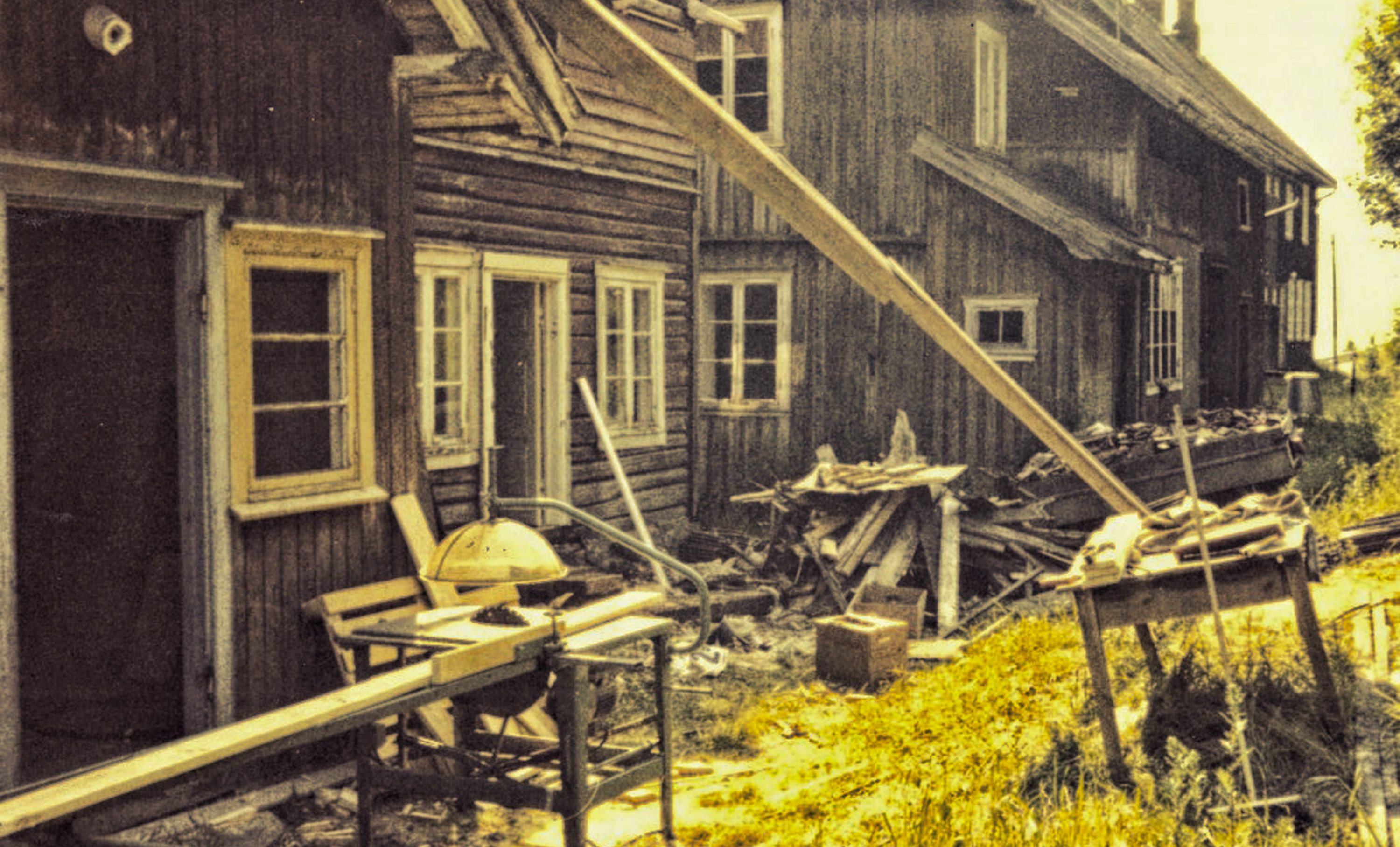
In the 1970s, Eidsfoss was in the throes of economic decline. Many houses stood empty, Bråtagata was in a state of disrepair, and nature had begun to reclaim the old workers’ housing.
In 1977, following an application from Eidsfos Verk, the Building Committee of Hof Municipality decided that three of the workers’ homes on Bråtagata were to be demolished. The decision also received unanimous support from the Cultural Affairs Committee. Later that same year, the bakery was demolished, as was the pier at Kølabånn. Eidsfos Verk also had plans to redevelop the workers’ housing on Gata and Hauane.
The threat of demolition sparked local engagement. Some wanted to demolish the buildings, others wanted to preserve them, whilst many adopted a wait-and-see attitude. In any case, the prerequisite was that, if the buildings were to be preserved, they would have to be put to use and given a new lease of life – they could not be left to stand and fall into disrepair year after year.
A major breakthrough came when the Director-General of Cultural Heritage became involved. In 1978, Eidsfoss was designated as ‘a unique industrial heritage site’, comprising the workers’ housing estates in Bråtagata, Gata and Hauane, as well as the factory site and Hovedgården. The County Conservator, Erling Eriksen, endorsed this assessment.
From activism to foundation
Around Christmas 1978, Fred Nordseth invited a group of people committed to conservation to a meeting, one of the aims of which was to establish an interim board for a potential foundation. Around 20 people attended. At the meeting, a draft plan for Bråtagata, drawn up by the architectural firm Planteknisk Institutt in Oslo, was also presented.
Gradually, the foundation developed an overall plan for the whole of Eidsfoss. The idea was that the historic buildings should be preserved through active use. The plans included, amongst other things, housing, a café, an ironworks museum and a school museum, as well as venues for handicrafts and arts and crafts, music, lectures and other events.
The aim was not only to preserve the buildings, but to create a vibrant Eidsfoss. As part of this work, it was also decided to reintroduce Eidsfoss Day.
A long battle for preservation
The battle for Eidsfoss continued with great intensity over the following years. The main opponents were Eidsfos Verk and the Norwegian Public Roads Administration, but local politicians also wanted to demolish parts of the settlement.
Gradually, new figures joined the Public Roads Administration, and attitudes began to change. Bjørn Schøye of the Public Roads Administration outlined a so-called ‘Strategy C’ solution to the traffic challenges, involving pedestrian crossings combined with raised crossings. This made it possible to reconcile road safety considerations with the desire to preserve the historic buildings.
The Public Works Department also gradually changed its stance, although the preservation of the houses at nos. 46 and 47 hung in the balance for a long time.
After a fierce battle lasting more than three years, the outcome was preservation rather than demolition.
The local commitment that began in the 1970s thus laid the foundations for the Eidsfoss we know today – a vibrant cultural environment where history is not only preserved, but continues to be used and experienced.
Contact
Fred Nordseth
Email: fred.nordseth@gmail.com
Phone: +47 958 72 618
The Old Eidsfos Foundation’s home page