


As early as 1683, it was decided that the mines in Norway should run schools for the miners’ children. The School Ordinance of 1739 stipulated that permanent school buildings were required at the mines. All children aged between 7 and 10 were to be taught Christianity and reading, whilst writing and arithmetic were optional.
The Eidsfoss Ironworks school was probably first housed in the area called ‘Pynten’, the building where the provisions manager or coal clerk was based. In the tax register for Eidsfoss Ironworks for 1766–69, Niels Flyborg and Lars Nielsen Tive are listed as schoolmasters. Lars Tive’s house consisted of four rooms with an iron stove and a veranda outside. He lived there with his family and taught the works’ children.
Around 1800, the works’ owner, Peder Cappelen, donated a sizeable collection of books to the school, and in 1808, Dean Hopstock remarked that teacher Erik Bruun and his pupils were doing very well indeed.
The school house at Hauane was built in 1843, and the last teacher employed by Eidsfoss Ironworks was Ludvig Adolf Sannes in 1875. That same year, his goddaughter Elise Jørgine Jensdatter Bollerud started at the school. The exhibition ‘For Elise’ next to the Old Eidsfos Inn is dedicated to her life at Eidsfoss.
Towards the end of the 19th century, the school here at Eidsfoss was inspired by Grundvigian ideas. This meant that all people, including women, were equal in God’s eyes, and it entailed an optimistic view of creation and human potential. This was a body of thought that lay far removed from that of the fire-and-brimstone preachers, and which found particular expression at one of the era’s key intellectual centres, Klæbu Teacher Training College. It was here that Ludvig Adolf Sannes was educated, and he most likely brought these ideas with him when he was appointed as a teacher at Eidsfoss in 1875.
The ironworks’ school became a municipal school in 1875. In 1893, it was replaced by a new, modern school building situated outside the residential areas of the works. The pupils moved to Hof School in 1957.
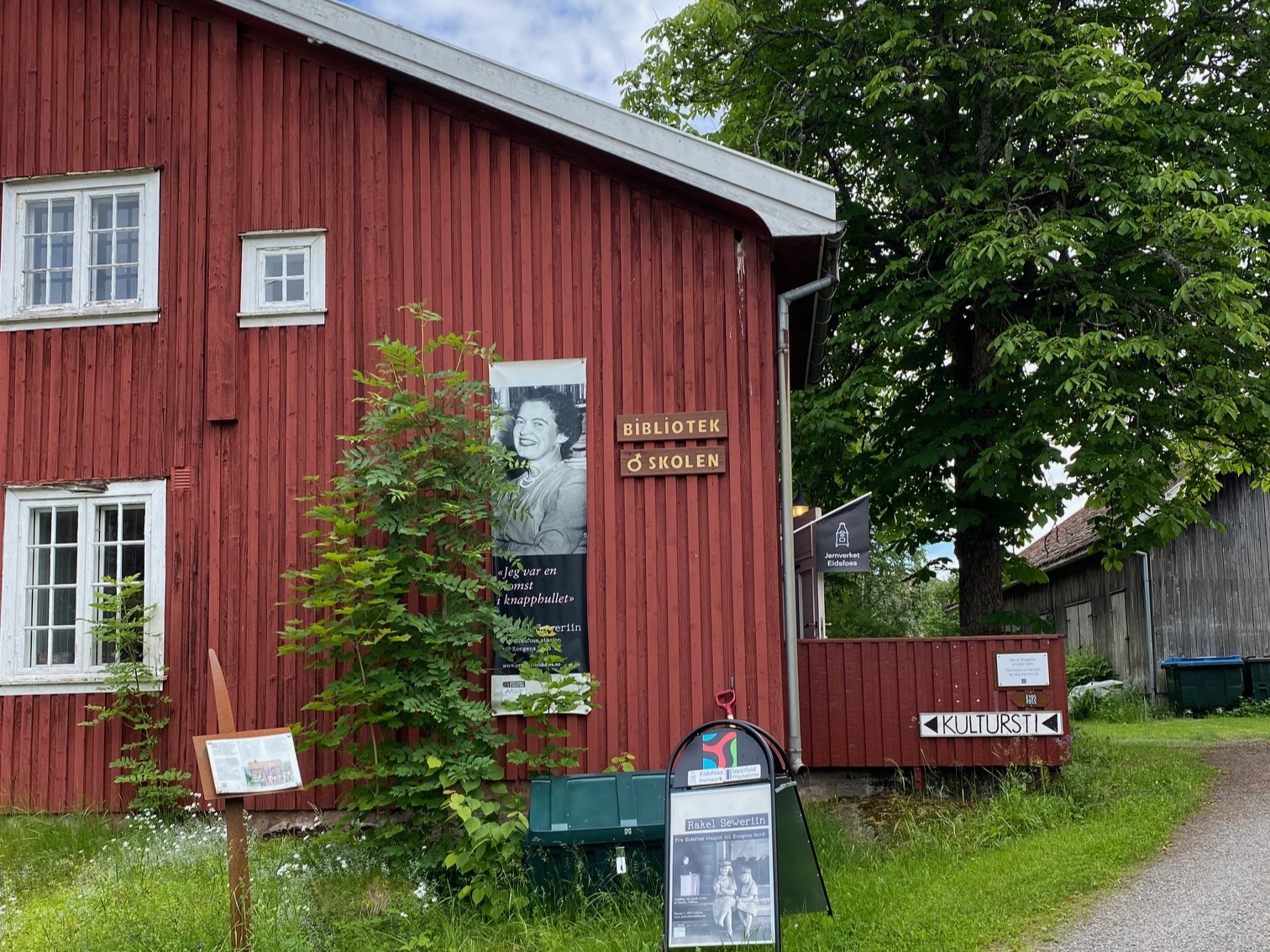
In more recent times, the Old School House was a branch library here until 2005. Today, the building houses the offices of the Eidsfoss Development Project and the Vestfold Museums, the school museum and the exhibition on Rakel Seweriin.
Other buildings near Skolestua
‘Bekken’
The building called ‘Bekken’ originally consisted of three timber-framed and log-built houses and was, in the old days, used to distribute ‘victualies’ (food) to the workers as part of their wages. In the late 1870s, it became the manager’s residence for the then manager, Christian Olsen Thon, who later became the owner and director of A/S Eidsfos Verk. The building was refurbished in the 1870s and demolished in 1965. It was rebuilt as a private residence in its original style and completed in 2005. Please be considerate.
‘Pynten’
The house called ‘Pynten’ has served many purposes throughout its history. Among other things, it served as accommodation for the ‘Kølaskriveren’ at the mill, who recorded the deliveries from the ice transporters. It also functioned as an inn, providing travellers with rest and food before their journey home. In the 1980s, the house was used as a youth club. Today, it is a privately owned residential property. Please be considerate.
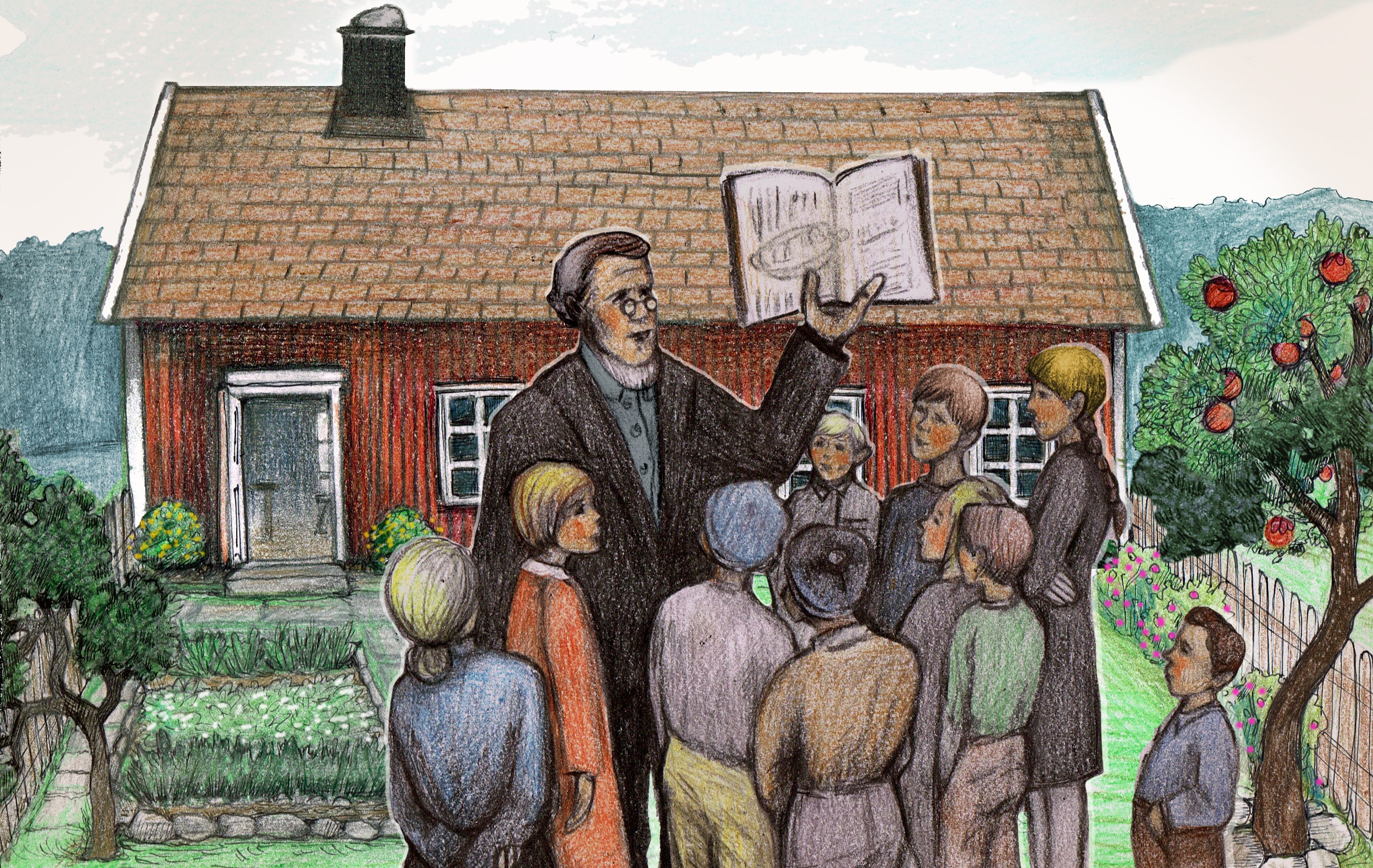
The drawing at the top of this page shows what Skolestua at Hauane most likely looked like when Sannes began teaching here in 1975. The section on the right, where the school museum is now located, was added later.
Illustrastion: Marianne Karlsen