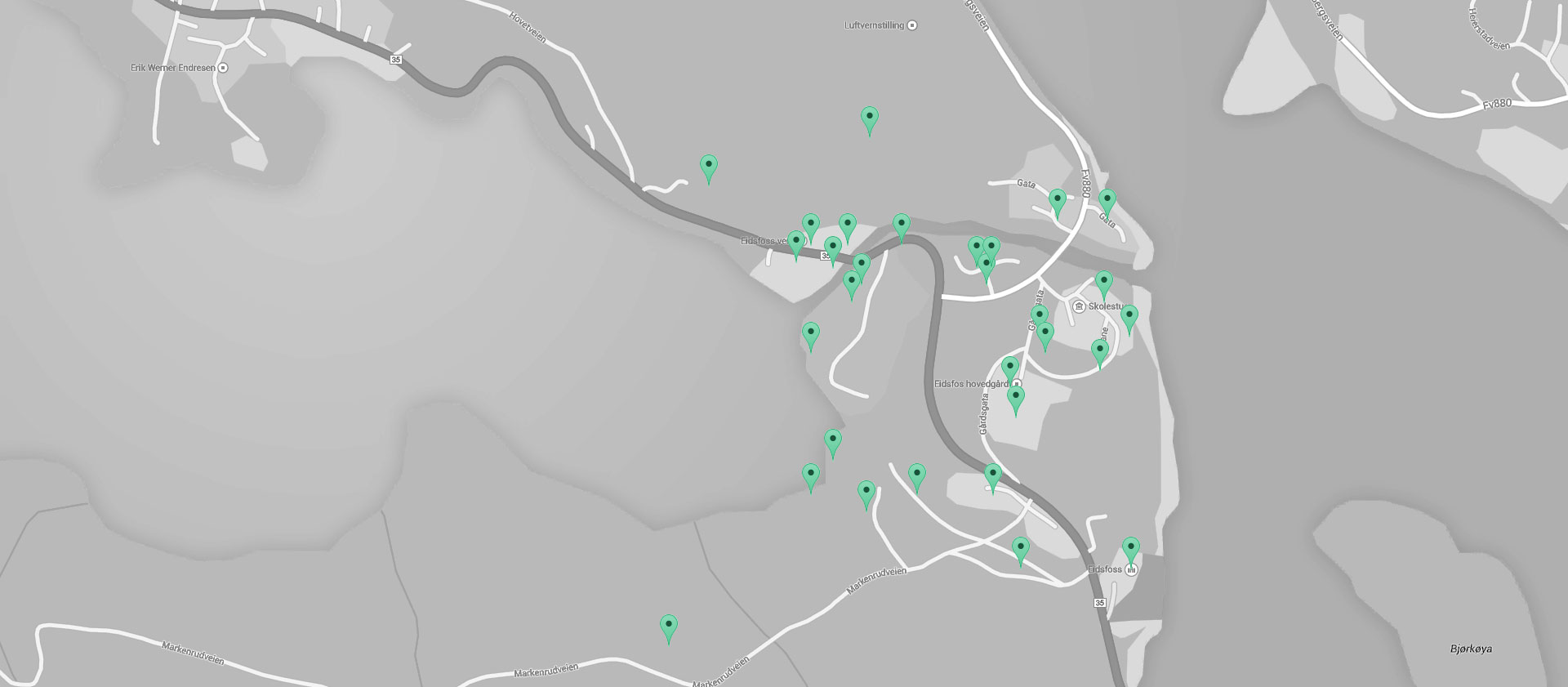



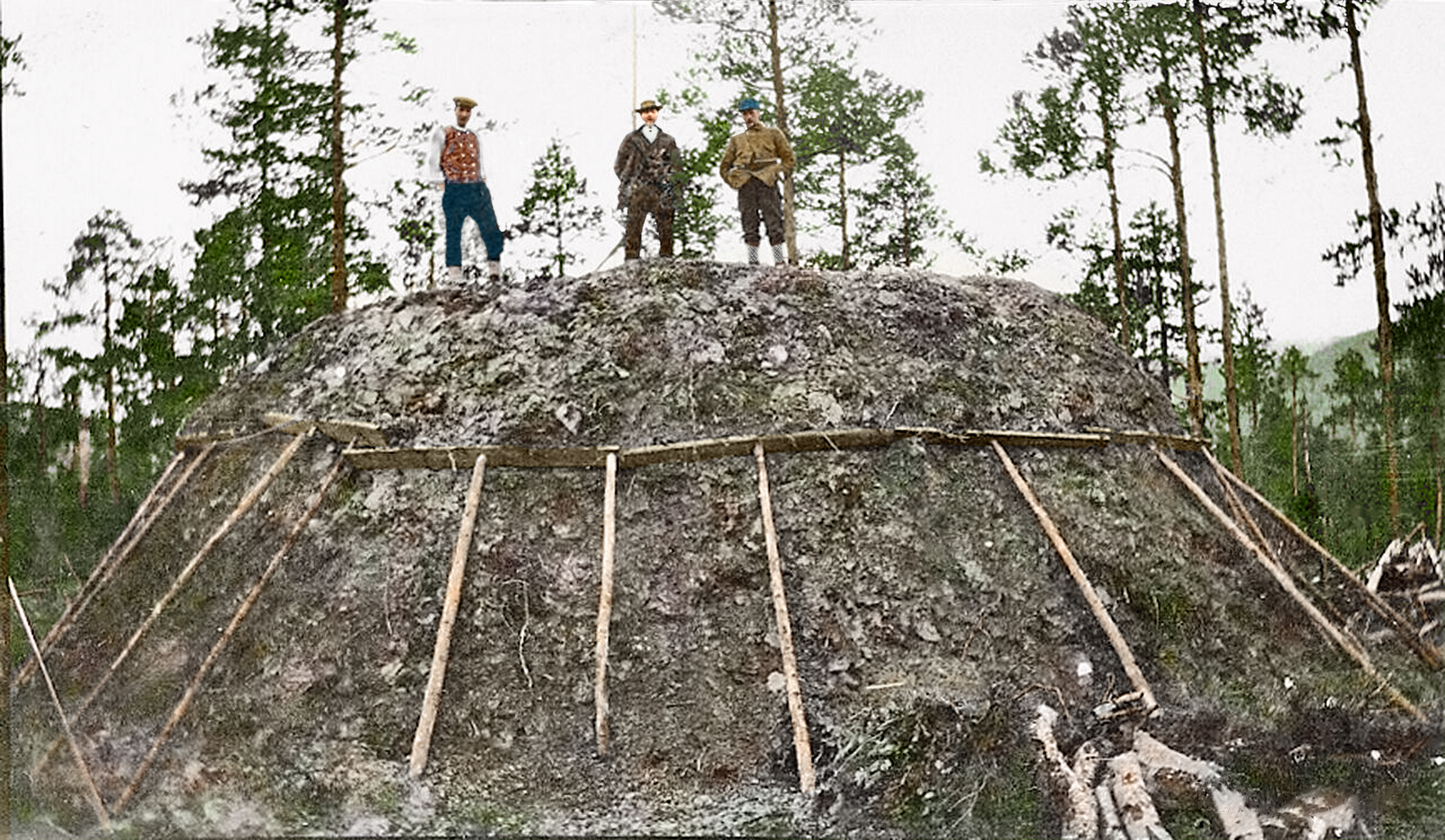
Charcoal burning took place mainly in the wooded areas around Eidsfoss, but the name Kølabånn suggests that charcoal was also produced here. It is said that in days gone by, when housewives hung their laundry out to dry in Bråtagata, they were greatly annoyed by the black smoke from Kølabånn.
To produce iron, one needed water power, iron ore and charcoal. Within the ‘circumference’ – an area stretching approximately 3 mil in every direction and encompassing around 300 farms – the farmers were obliged to transport ore and charcoal to the ironworks. The prices of coal and transport were set by the King in Copenhagen, and were the subject of disagreement on several occasions.
The ‘Kølabrenneren’ and the ‘Kølakjøreren’ were at the bottom of the hierarchy of the ironworks, but charcoal burning also provided a welcome source of extra income for the small farmers in the region. By the end of the 19th century, however, the industry had switched entirely to hard coal and coke, thus bringing to an end a two-hundred-year tradition of charcoal burning.
The surface of a ‘charcoal kiln’ is sealed with, for example, clay or earth. The kiln has a firing channel in the centre and air vents on the sides. The lack of air during burning means that only the sap and water evaporate. The temperature must not become too high, otherwise the wood will burn up; this is regulated by adjusting the supply of oxygen via the air channels. A charcoal kiln burns for 12–16 days, and during this time the calorific value doubles. At the same time, around 40 per cent of the wood’s volume is lost. One pile yielded approx. 9 læster (= loads) of charcoal, and the mill required around 10,000 loads per year. These were mainly transported in winter to Eidsfoss by horse and sledge, and stored in the large charcoal sheds.
The Tønsberg–Eidsfoss Railway
The embankment at Kølabånn shows that this is where the railway line for the Tønsberg–Eidsfoss Railway ended. From the mid-20th century onwards, Kølabånn was used, amongst other things, as a storage area for planks that had been cut at the sawmill just a stone’s throw away.
The Steamship Stadshauptmand Schwartz
The steamship Stadshauptmand Schwartz was trafficking the lake Eikern between 1903 and 1926. The route was part of a fashionable roundtrip between Kristiania (Oslo) and Tunsberg (Tønsberg). The ship was named after the owner of the ironworks, Stadshauptmand Johan Jørgen Schwartz.
The ship was built (in sections) at Drammen Iron Foundry and Mechanical Workshop. The sections were transported by train from Drammen to Tønsberg and on to Eidsfoss, where they were assembled at Kølabånn.
At the time, the ship was owned by Ekerns Dampskibsselskap, whose purpose was to operate passenger, postal and freight services on Lake Eikern. During the economic downturn in the 1920s, the company got financial problems. After being out of service for several years, the ship sank in 1931, while moored. Attempts to raise her in 1933 and 1972 failed, but on 28 October 1995, a group of locals finally succeeded.
Today, the boat is owned by the Eikerns Dampskipsselskap Association, which has restored it as a “Cultural Heritage on Land”.
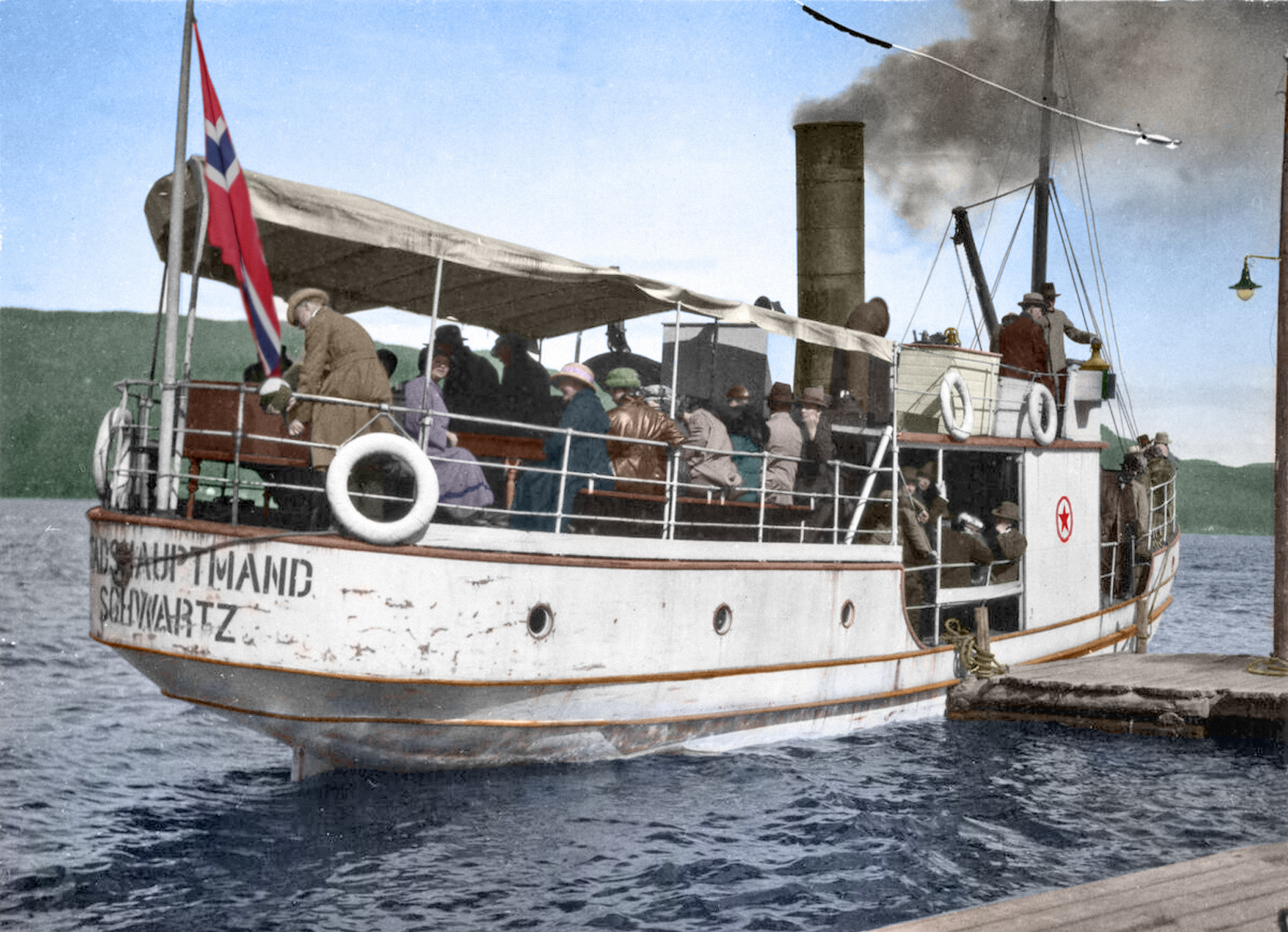
Photo: Buskerud County Archives. Hand-coloured by Bjørn Vangen
The video clip below is from a movie made by Christian Erik Nordby. A full-length DVD can be bought at Eidsfos country store.
Main photo: Anno Museum Musea i Nord-Østerdalen fotoarkiv. Hand colored by Bjørn Vangen